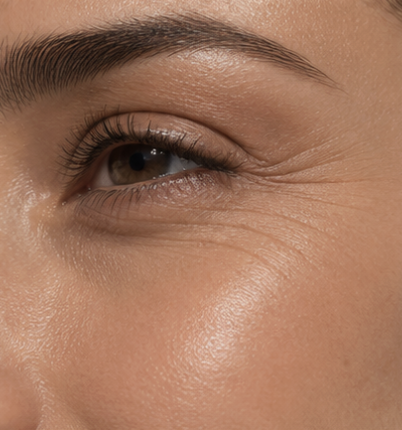
How many units crow's feet take
Most patients need 6 to 12 units per side, so 12 to 24 units total. The range is wide because the orbicularis oculi varies a lot between people.
Factors that push dosing higher:
- Strong, expressive smiles that recruit the whole muscle
- Larger muscle mass, more common in men
- Lines that extend down toward the cheek rather than staying at the corner
- A history of treatment where the muscle has not yet reduced
Factors that push dosing lower:
- Thin skin and a fine, shallow line pattern
- Prior consistent treatment, which reduces muscle strength over time
- Wanting to preserve obvious movement
At $16 per unit standard and $14.40/unit for members, a crow's feet treatment usually lands between $192 and $384. Most patients treat crow's feet alongside forehead and glabella, and the combined visit runs 40-60 units.
What it changes and what it does not
Botox works on dynamic lines — the ones that appear when the muscle moves. Crow's feet on smiling are the textbook case, and they respond well.
Static lines are the ones visible when your face is completely at rest. These are creases that have been folded so many times the skin itself has changed. Botox softens them over months of consistent treatment, because the skin is no longer being folded and gets a chance to remodel, but it does not erase them in one visit.
If your lines are deeply etched at rest, expect meaningful softening rather than disappearance, and expect the improvement to build across two or three treatment cycles. Skin-quality work — microneedling, resurfacing, retinoids — addresses the textural component that Botox cannot.
One thing Botox in this area does not treat is under-eye hollowing or crepey skin below the lash line. Different problem, different tools.
Why we leave some movement
The outer eye is where an over-treated face gives itself away.
When the orbicularis oculi is fully shut down, the eye stops narrowing on a smile. The mouth moves, the eyes do not, and the expression reads as flat or insincere even to people who could not tell you why. It is the single most recognizable sign of aggressive neuromodulator dosing.
We dose so that a slight crinkle remains at full smile. That preserves the way your eyes participate in expression while removing the hard folded lines. If you have been treated elsewhere and felt your smile looked wrong afterward, this is almost always the reason — and it is correctable simply by dosing lower on the next round.
Placement and safety around the eye
Crow's feet injections are placed superficially, in a small arc lateral to the orbital rim, typically at three points per side. Staying lateral matters: product placed too far medially or too low can reach muscles that control the lower lid or the smile, which is how the rare complications in this area occur.
Realistic side effects are minor. Bruising is the most common — the outer eye has visible superficial vessels, and a small bruise there is easy to conceal but happens more often than on the forehead. Some patients notice a brief feeling of tightness for a few days.
The whole treatment takes a few minutes and needs no downtime. Avoid rubbing the area, lying flat, or strenuous exercise for four hours afterward.
Timing and maintenance
Onset begins at day 3 to 5 and the result is complete by day 14. If you have an event, treat at least two weeks ahead — both so the effect is settled and so any bruise has resolved.
Duration is 3 to 4 months, similar to other neuromodulator areas. Patients who exercise heavily sometimes metabolize faster and return closer to the three-month mark.
The area rewards consistency. Muscles that are treated regularly weaken over time, so long-term patients often find they need fewer units to hold the same result — which makes the ongoing cost lower than the first visit suggests.