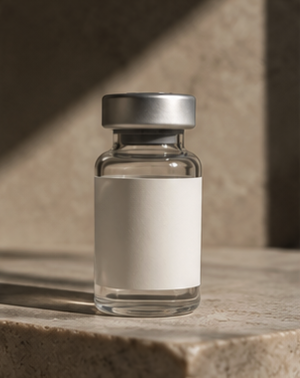
The ingredient list
A vial of Botox Cosmetic contains three things:
- OnabotulinumtoxinA — the active protein, measured in units
- Human albumin — a stabilizing protein that keeps the active ingredient from sticking to the vial and degrading
- Sodium chloride — plain salt, for tonicity
That is the entire formulation. There are no preservatives in the standard product, no animal-derived collagen, and no live organisms. Immediately before treatment the vial is reconstituted with sterile saline, which is what makes it injectable.
Dysport, the other neuromodulator we stock, uses abobotulinumtoxinA with human albumin and lactose. It is the same class of medicine with a slightly different molecular presentation, which is why the unit scales are not interchangeable between the two.
Where it comes from
Botulinum toxin type A is produced in a controlled fermentation process using Clostridium botulinum. The protein the bacteria produce is then separated out and purified through multiple steps until what remains is the isolated protein alone.
The finished product contains no bacteria. This is the same manufacturing logic behind many biologic medicines — the organism is a production method, not an ingredient.
Every vial is assayed for potency, which is what the "unit" measures. A unit is a standardized measure of biological activity, not a measure of volume — which is why 20 units of Botox and 20 units of Dysport are not the same amount of medicine.
How it works once injected
Nerves tell muscles to contract by releasing a signaling chemical called acetylcholine at the junction between the nerve ending and the muscle. Botulinum toxin type A blocks that release.
The muscle receives no signal, so it does not contract. Skin over a muscle that is not folding does not crease.
The effect is temporary because the body rebuilds the blocked machinery and grows new nerve terminals over roughly three to four months. Nothing is permanently removed or destroyed; the blockade simply wears off, and the muscle returns to full function.
The effect also stays where it is placed. Diffusion from the injection site is measured in millimeters, which is why placement precision matters and why the product does not travel through the body.
Is it safe?
Botulinum toxin type A has been used medically since the 1970s — originally for eye muscle disorders — and received FDA approval for cosmetic use in 2002. It is one of the most studied drugs in aesthetic medicine, with decades of published data across both cosmetic and therapeutic indications including migraine, cervical dystonia, and excessive sweating.
The safety margin is a function of dose. A typical full-face cosmetic treatment uses 40 to 60 units. Estimated hazardous systemic doses are in the thousands of units. The gap is very large, and cosmetic dosing does not approach it.
The real risk profile in cosmetic use is local and technique-dependent: bruising, temporary heaviness if the forehead is over-treated, and rarely a droop from misplacement. These resolve as the product wears off.
Contraindications exist and should be screened at consultation — pregnancy, breastfeeding, certain neuromuscular conditions, active infection at the site, and known allergy to any component including albumin.
Why the brand name matters
"Botox" is a brand, the way "Kleenex" is. The category is neuromodulators, and the FDA-approved products in the US include Botox, Dysport, Xeomin, Jeuveau, and Daxxify.
Buying a brand you can name is a meaningful safety step. Counterfeit and unapproved neuromodulators circulate, and they are the source of most of the alarming stories that surface periodically. At Plump we stock Botox and Dysport, both sourced through authorized distribution, and we open the vial in the room.
If a provider will not tell you which product they are using, what it cost, and how many units they are placing, that is the question to press on.